 Enes Guven
In the first two parts of our series, we architected the robust transport highways and implemented strict Zero Trust micro-segmentation. However, a flawless network architecture is meaningless if it cannot survive a catastrophic failure, if security blind spots go unnoticed, or if it bankrupts the IT budget.
In this final installment, we shift our focus from prevention to resilience, operations, and cost optimization. We will explore how to utilize Azure as a seamless Disaster Recovery Center (DRC), continuously audit cloud configurations via Microsoft Defender, unify telemetry using Microsoft Sentinel, and apply FinOps principles to maximize security ROI.
1. Business Continuity: Azure Site Recovery (ASR)
Traditional Disaster Recovery (DR) involves maintaining a secondary, physical datacenter that sits idle, consuming massive capital expenditures (CAPEX) for cooling, power, and hardware. A hybrid cloud model revolutionizes this by using Azure as a dynamic, scalable DR site.
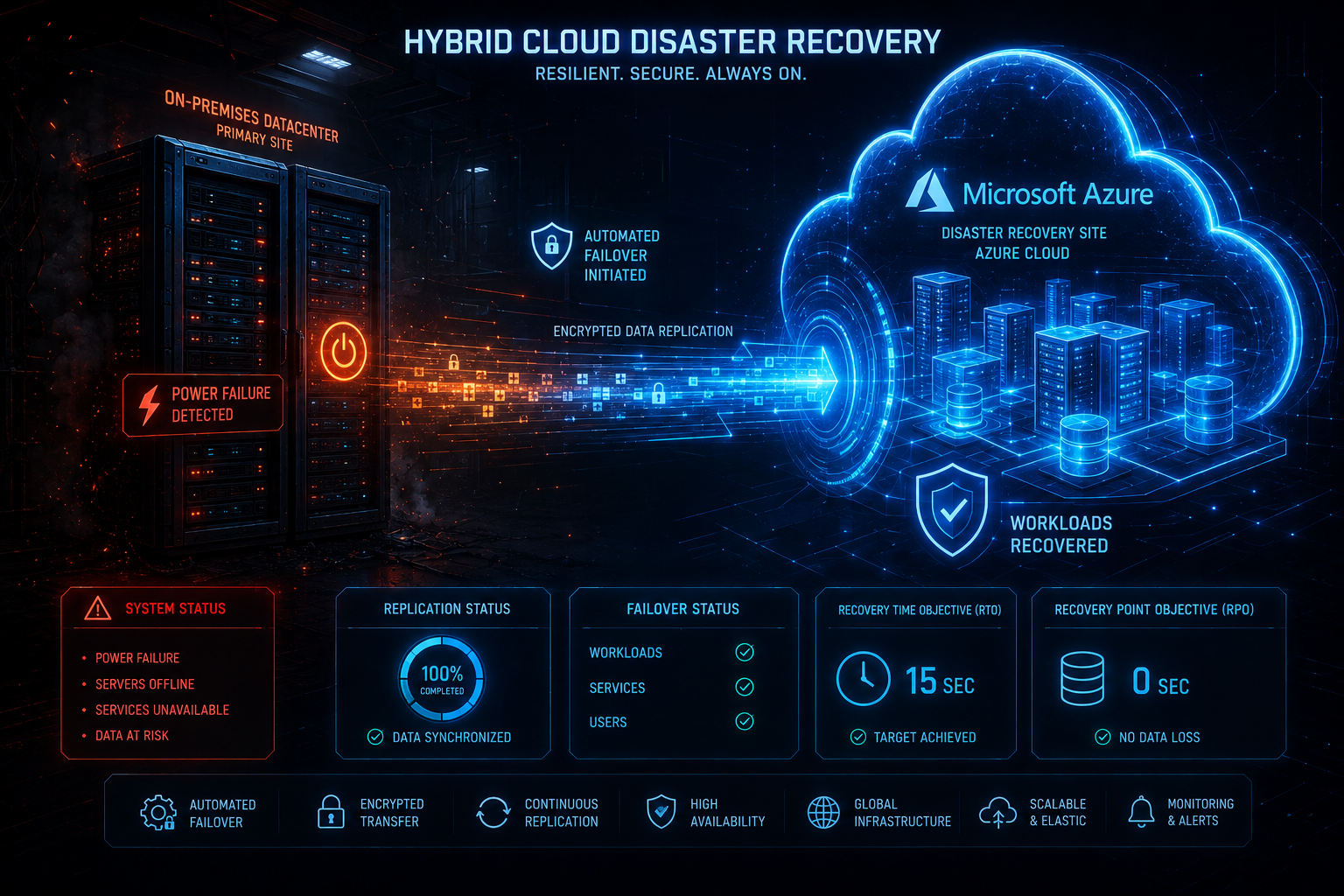
Using Azure Site Recovery (ASR), mission-critical On-Premises VMware or Hyper-V Virtual Machines are continuously replicated to Azure Managed Disks. During normal operations, you only pay for the storage costs. In the event of a primary datacenter failure—be it a power outage, hardware crash, or a widespread ransomware encryption event—the DR playbook is triggered.
ASR orchestrates the failover, attaching the replicated disks to newly spun-up Azure Virtual Machines within the pre-configured Spoke VNets. Within minutes, traffic is rerouted via Azure Front Door, and business operations resume seamlessly. The Recovery Time Objective (RTO) drops from days to minutes.
2. Posture Management: Microsoft Defender for Cloud
Cloud environments are highly dynamic. An engineer might temporarily open port 3389 (RDP) to the internet for troubleshooting and forget to close it, instantly creating a severe vulnerability. Security must be continuously audited.
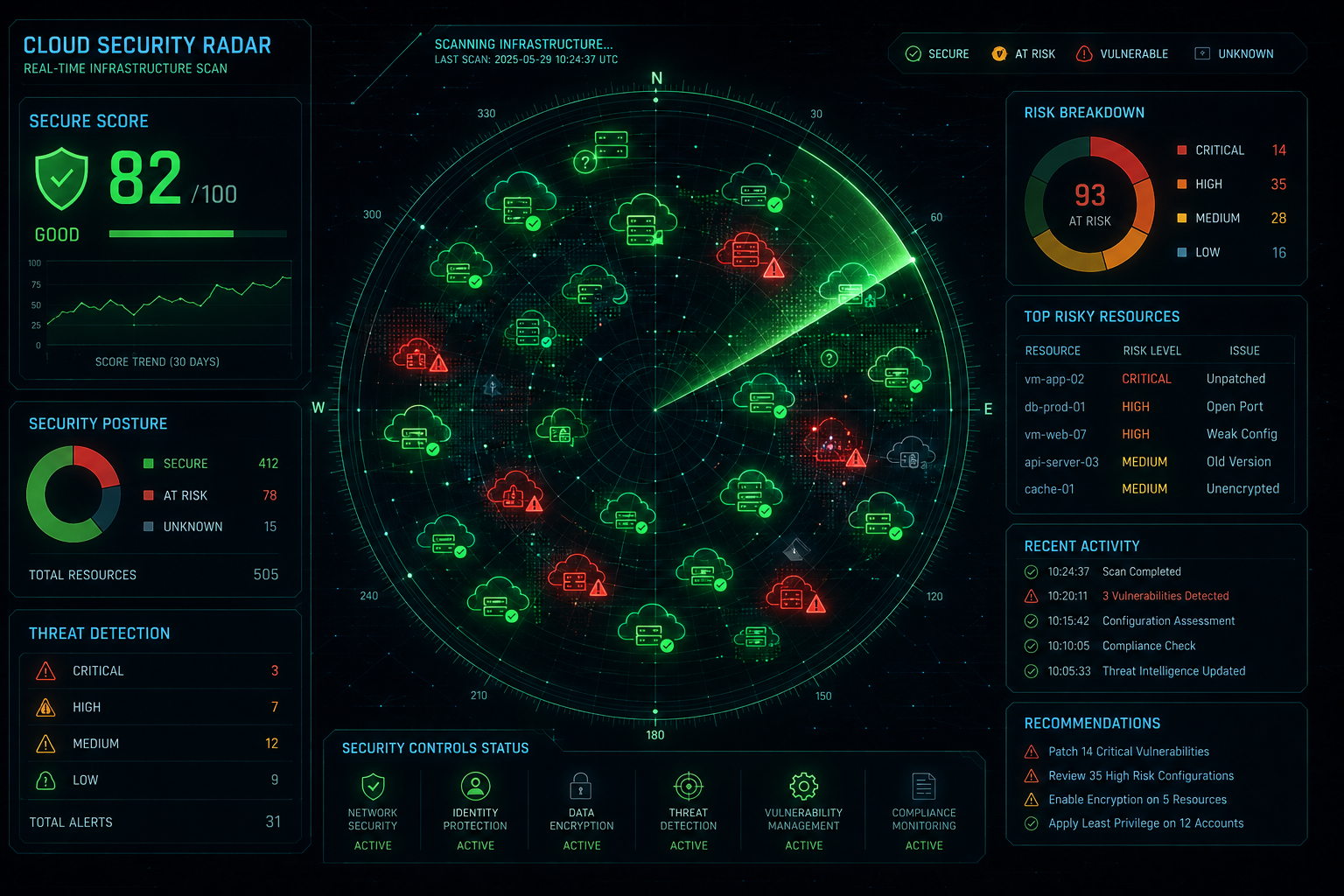
Microsoft Defender for Cloud acts as a Cloud Security Posture Management (CSPM) tool. It continuously scans Azure subscriptions, identifying misconfigurations and comparing them against regulatory benchmarks like PCI-DSS or ISO 27001.
The primary metric is the Secure Score. Defender highlights critical issues, such as unencrypted storage accounts, missing endpoint protection agents, or overly permissive Network Security Groups (NSGs). By remediating these findings, organizations proactively shrink their attack surface before adversaries can exploit it.
az security secure-scores list --output table
Name CurrentScore MaxScore Percentage
------------- ------------ --------- ----------
ascScore 42.5 60.0 70.83%
az security alert list --query "[?properties.severity=='High'].{AlertName:name, Severity:properties.severity}" --output table
AlertName Severity
------------------------------------------------- --------
VM has an open Management Port (RDP) High
Storage Account is missing encryption in transit High3. Hybrid SIEM & Threat Hunting: Microsoft Sentinel
The ultimate challenge in a hybrid architecture is visibility. If an attacker attempts to brute-force an On-Premises VPN gateway and simultaneously launches a credential stuffing attack against an Azure-hosted application, legacy on-prem SIEMs will often miss the correlation.
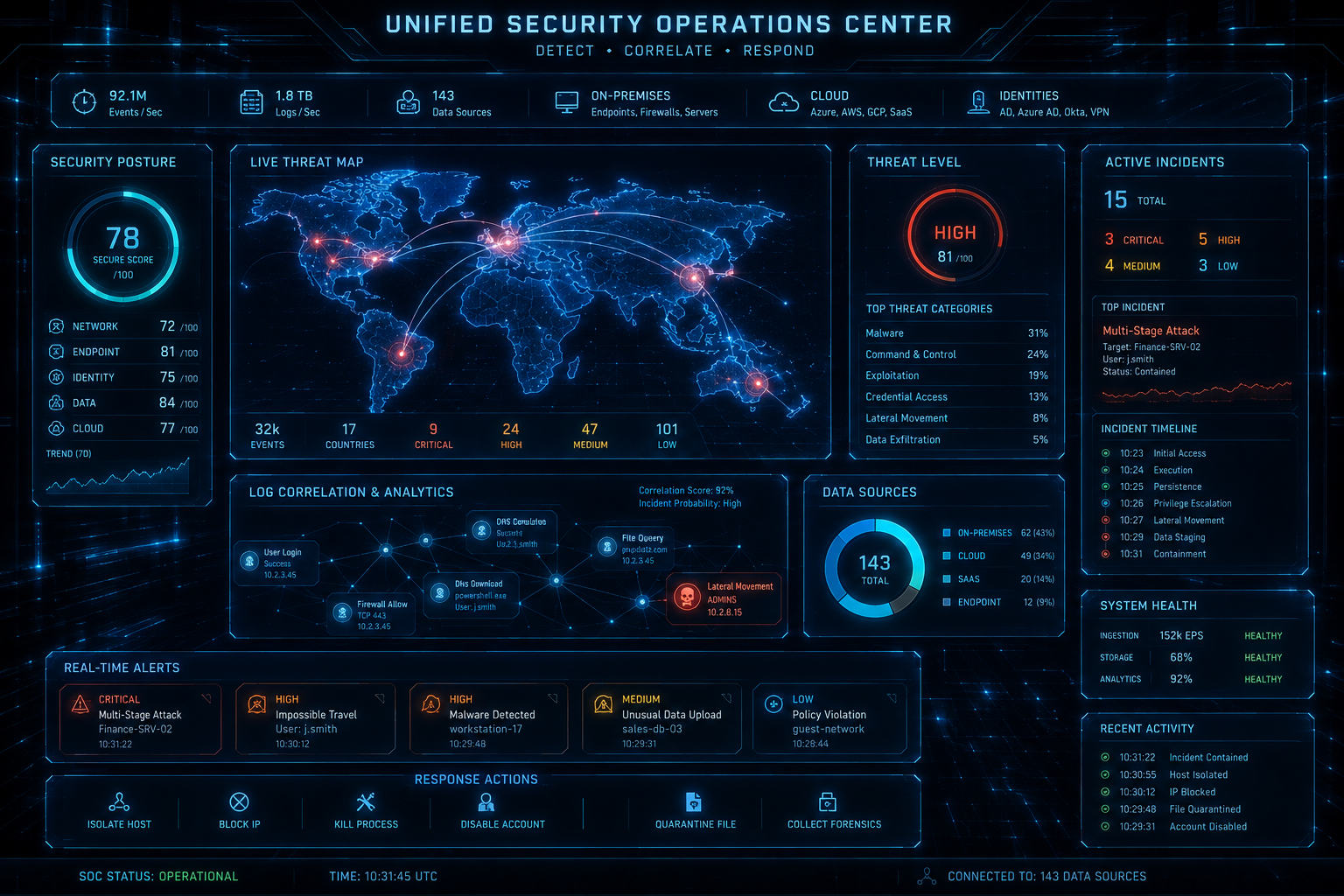
Microsoft Sentinel is a cloud-native Security Information and Event Management (SIEM) and Security Orchestration, Automation, and Response (SOAR) platform. It ingests telemetry from across the entire hybrid spectrum into a unified Log Analytics Workspace.
We deploy Azure Arc and Log Analytics agents to On-Premises Domain Controllers and firewalls (e.g., FortiGate via Syslog/CEF), while natively connecting Entra ID, Azure WAF, and Azure Firewall logs. Sentinel’s machine learning engines correlate these disparate data streams, allowing SOC analysts to hunt for advanced persistent threats (APTs) using Kusto Query Language (KQL).
// Correlating On-Premises VPN Failures with Azure Resource Access
let SuspiciousIPs =
CommonSecurityLog
| where DeviceAction == "Deny" and DestinationPort == "443"
| summarize count() by SourceIP
| where count_ > 50
| project SourceIP;
AzureActivity
| where CallerIpAddress in (SuspiciousIPs)
| where OperationNameValue contains "MICROSOFT.COMPUTE/VIRTUALMACHINES"
| project TimeGenerated, Caller, CallerIpAddress, OperationNameValue, ResourceGroup
| order by TimeGenerated desc
[Result]:
2026-01-18T18:42:10Z
CallerIpAddress: 198.51.100.42 (Matches On-Prem VPN Brute Force)
Caller: admin_service_account@kurumsal.com
Operation: MICROSOFT.COMPUTE/VIRTUALMACHINES/START/ACTION4. FinOps & Cost Optimization: Maximizing Hybrid Security ROI
A true enterprise architect knows that a perfectly secure system is a failure if it exhausts the IT budget. FinOps (Cloud Financial Management) must be integrated directly into the security architecture.
- Sentinel Log Data Tiering: Ingesting terabytes of logs into a SIEM is expensive. Not all logs require expensive 90-day hot analytics retention. By routing high-volume, low-security-value logs (e.g., standard firewall 'Accept' traffic or flow logs) into the Basic Logs tier or Azure Data Explorer (ADX), organizations can reduce their SIEM ingestion costs by up to 70% without sacrificing compliance.
- Reserved Instances for Security Appliances: Core hybrid infrastructure, such as the Azure Firewall in your Hub VNet or continuous Domain Controllers, run 24/7. Committing to a 1-year or 3-year Azure Reserved Instance (RI) for these specific resources significantly slashes compute rates.
- Azure Hybrid Benefit: When a disaster occurs and ASR spins up your On-Premises workloads in the cloud, you shouldn't pay for the OS license twice. By utilizing Azure Hybrid Benefit, you can apply your existing On-Premises Windows Server and SQL Server licenses to the Azure VMs, paying only for the underlying compute infrastructure.
Conclusion of the Series
A true Enterprise Hybrid Cloud Architecture is not achieved by merely connecting cables and establishing BGP routes. It requires a holistic, defense-in-depth strategy. By optimizing transport for resilience, enforcing Zero Trust at every layer, micro-segmenting workloads, uniting the environment under a cloud-native SIEM, and applying rigorous FinOps principles, organizations can achieve the perfect balance of agility, cost-efficiency, and ironclad security.