 Enes Guven
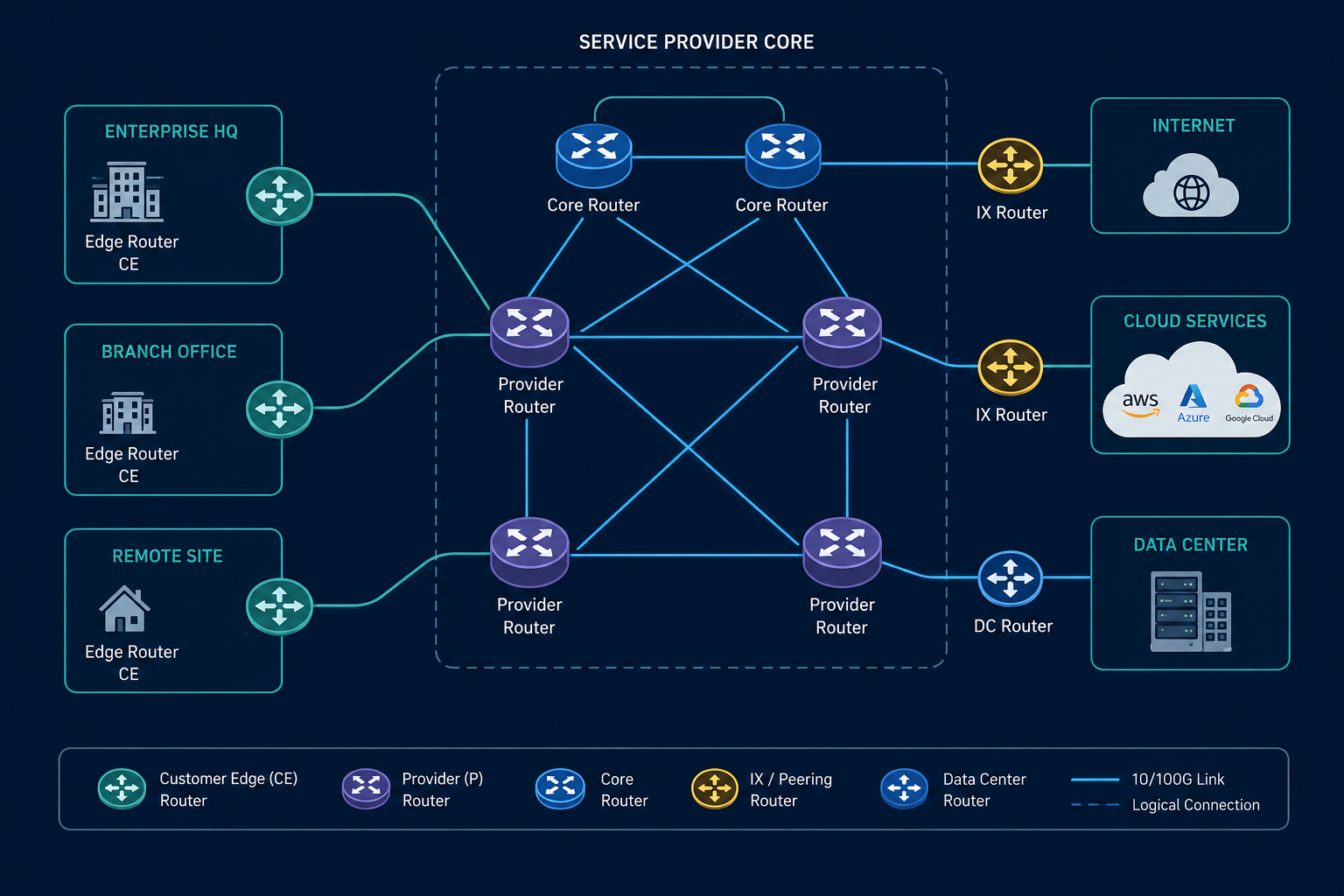
In Service Provider cores, Data Centers, and large Enterprise backbones, network operations are rarely homogeneous. Traffic frequently originates on a Cisco IOS-XR router, traverses a Huawei VRP MPLS core, passes through Nokia SR-OS provider edge nodes, and terminates on a Fortinet FortiOS security appliance.
When an outage occurs or prefixes go missing, knowing the exact diagnostic commands across multiple Operating Systems is vital. This field cheat sheet provides an immediate cross-reference guide for IS-IS, MPLS LDP, BGP, VRF instance inspection, and specific prefix lookups across all four major enterprise vendors.
1. IS-IS Routing Configuration & Adjacency
What it does: IS-IS (Intermediate System to Intermediate System) is heavily used as the Link-State IGP (Interior Gateway Protocol) in Service Provider backbones to distribute loopbacks and reachability before MPLS/BGP is built on top.
Use Case: Use these commands to inspect the running IS-IS process configuration and verify that L1/L2 neighbor adjacencies are formed and not flapping.
Inspect IS-IS Configuration
show run router isis COREdisplay current-configuration configuration isisinfo configure router isisshow router isisVerify IS-IS Neighbor Adjacencies
show isis neighborsdisplay isis peershow router isis adjacencyget router info isis neighbor2. MPLS LDP & Interface Status
What it does: LDP (Label Distribution Protocol) allocates and exchanges labels between Label Switching Routers (LSRs) to establish Label Switched Paths (LSPs) for MPLS VPN services.
Use Case: Troubleshoot MPLS transport failures. If LDP is disabled on an interface or LDP sessions fail to form, VPNv4/VPNv6 traffic will drop despite BGP being up.
Inspect MPLS LDP Configuration & Interfaces
show run mpls ldp
show mpls interfaces
display current-configuration configuration mpls ldp
display mpls interfaceinfo configure router mpls ldp
show router mpls interface3. Global BGP Configuration & Peer Summaries
What it does: BGP (Border Gateway Protocol) handles inter-AS routing and MP-BGP (Multiprotocol BGP) carries VRF customer routes (VPNv4/VPNv6) across the provider backbone.
Use Case: Quickly check global BGP configurations, Autonomous System (AS) definitions, and peer summary tables to confirm if TCP Port 179 connections are established.
show run router bgp 15924
show bgp summary
display current-configuration configuration bgp
display bgp peerinfo configure router bgp
show router bgp summaryshow router bgp
get router info bgp summary4. Static Routing Inspections (Global vs. VRF)
What it does: Static routes provide explicit manually defined paths, often used for customer WAN handoffs, out-of-band management, or default gateways inside VRF instances.
Use Case: Verify static route configurations both in the global routing table and within specific VRF / VPRN tenant instances.
show run router static address-family ipv4 unicast
show run router static vrf TEST address-family ipv4 unicast
display current-configuration | include static-rt
display current-configuration ipv4-family vpn-instance TESTinfo configure router static-route
info configure service vprn TEST static-routeshow router static5. VRF Routing Table Filtering (Static, Connected, BGP)
What it does: VRF (Virtual Routing and Forwarding) creates isolated routing instances on the same physical router, enabling multi-tenancy and L3VPNs.
Use Case: Filter a specific customer's VRF routing table by source protocol (Static, Connected, or BGP) to quickly isolate route installation issues.
show route vrf TEST static
show route vrf TEST connected
show route vrf TEST bgp
display ip routing-table vpn-instance TEST protocol static
display ip routing-table vpn-instance TEST protocol direct
display ip routing-table vpn-instance TEST protocol bgpshow router vprn TEST route-table static
show router vprn TEST route-table direct
show router vprn TEST route-table bgpget router info routing-table vrf <vrf_id>6. Specific Prefix Lookup (Global & VRF)
What it does: Queries the Routing Information Base (RIB) for a specific IP destination to view administrative distance, metric, next-hop, and outgoing interface.
Use Case: Essential for tracing traffic path selection or investigating why a specific destination IP is unreachable.
show route X.X.X.X
show route vrf TEST X.X.X.X
display ip routing-table X.X.X.X
display ip routing-table vpn-instance TEST X.X.X.Xshow router route-table X.X.X.X
show router vprn TEST route-table X.X.X.Xget router info routing-table detail X.X.X.X7. BGP Neighbor Specific Routes (Received vs. Advertised)
What it does: Inspects BGP Update messages sent to or received from a specific neighbor IP before/after route policy evaluation.
Use Case: Prove whether a route is being filtered by your inbound/outbound route-maps or if the remote peer is simply not sending the prefix.
Global BGP Received & Advertised Routes
show bgp neighbors X.X.X.X routes
show bgp neighbors X.X.X.X advertised-routes
display bgp routing-table peer X.X.X.X received-routes
display bgp routing-table peer X.X.X.X advertised-routesshow router bgp neighbor X.X.X.X received-routes
show router bgp neighbor X.X.X.X advertised-routesget router info bgp neighbors X.X.X.X received-routes
get router info bgp neighbors X.X.X.X advertised-routesVRF BGP Received & Advertised Routes
show bgp vrf TEST neighbors X.X.X.X routes
show bgp vrf TEST neighbors X.X.X.X advertised-routes
display bgp vpnv4 vpn-instance TEST routing-table peer X.X.X.X received-routes
display bgp vpnv4 vpn-instance TEST routing-table peer X.X.X.X advertised-routesshow router vprn TEST bgp neighbor X.X.X.X received-routes
show router vprn TEST bgp neighbor X.X.X.X advertised-routes