 Enes Guven
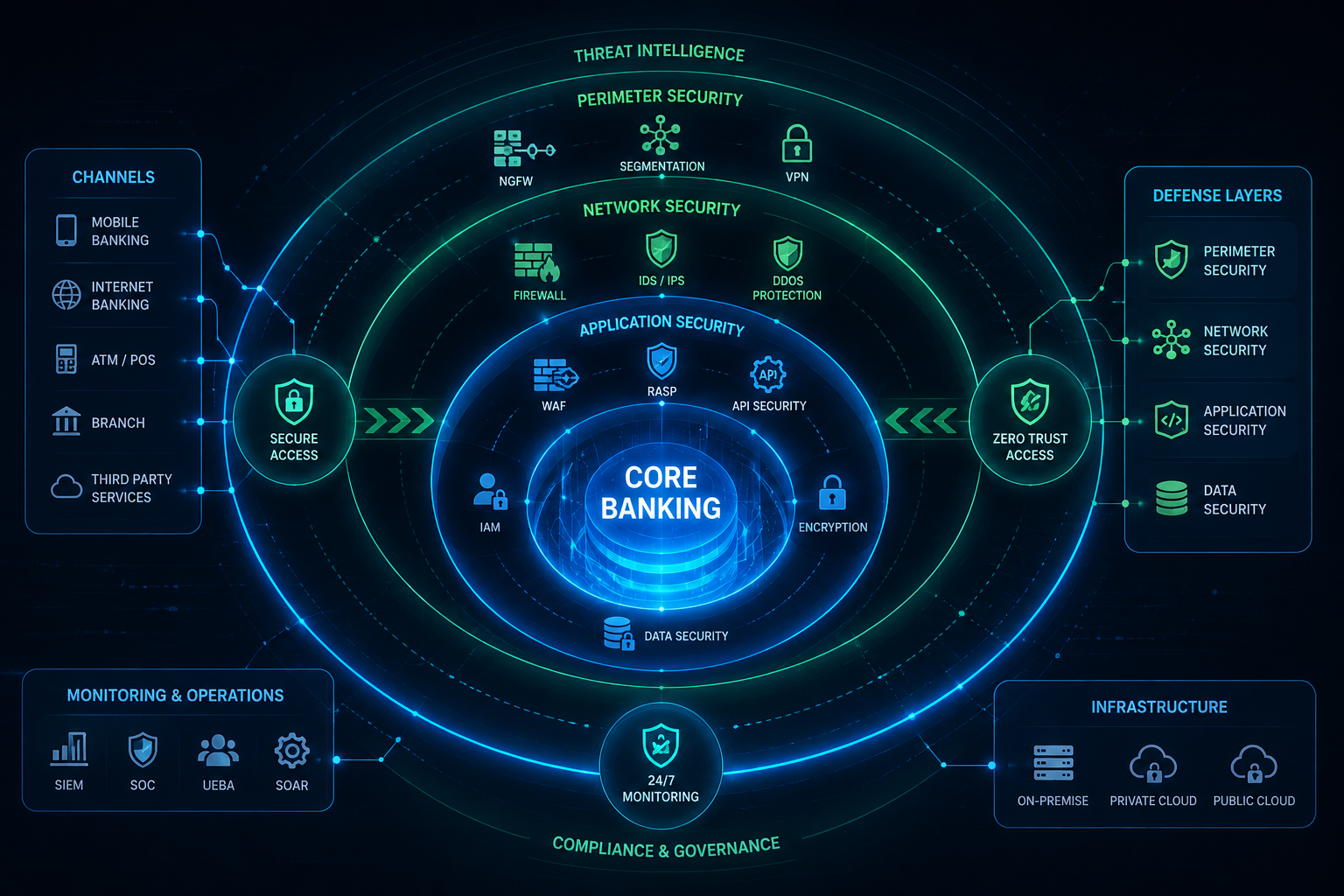
The financial sector operates under the most stringent regulatory pressures (BDDK, PCI-DSS, GDPR) while simultaneously serving as the primary target for advanced persistent threats (APTs), ransomware syndicates, and state-sponsored actors. In this high-stakes environment, the traditional "castle-and-moat" perimeter security model has collapsed.
Modern financial institutions require a holistic, Zero Trust architecture—a paradigm where trust is never implicitly granted based on network location, and every access request is rigorously verified. Below is the blueprint for building a resilient, defense-in-depth financial architecture across seven critical layers.
1. Perimeter & Application Edge: WAF & Mail Security
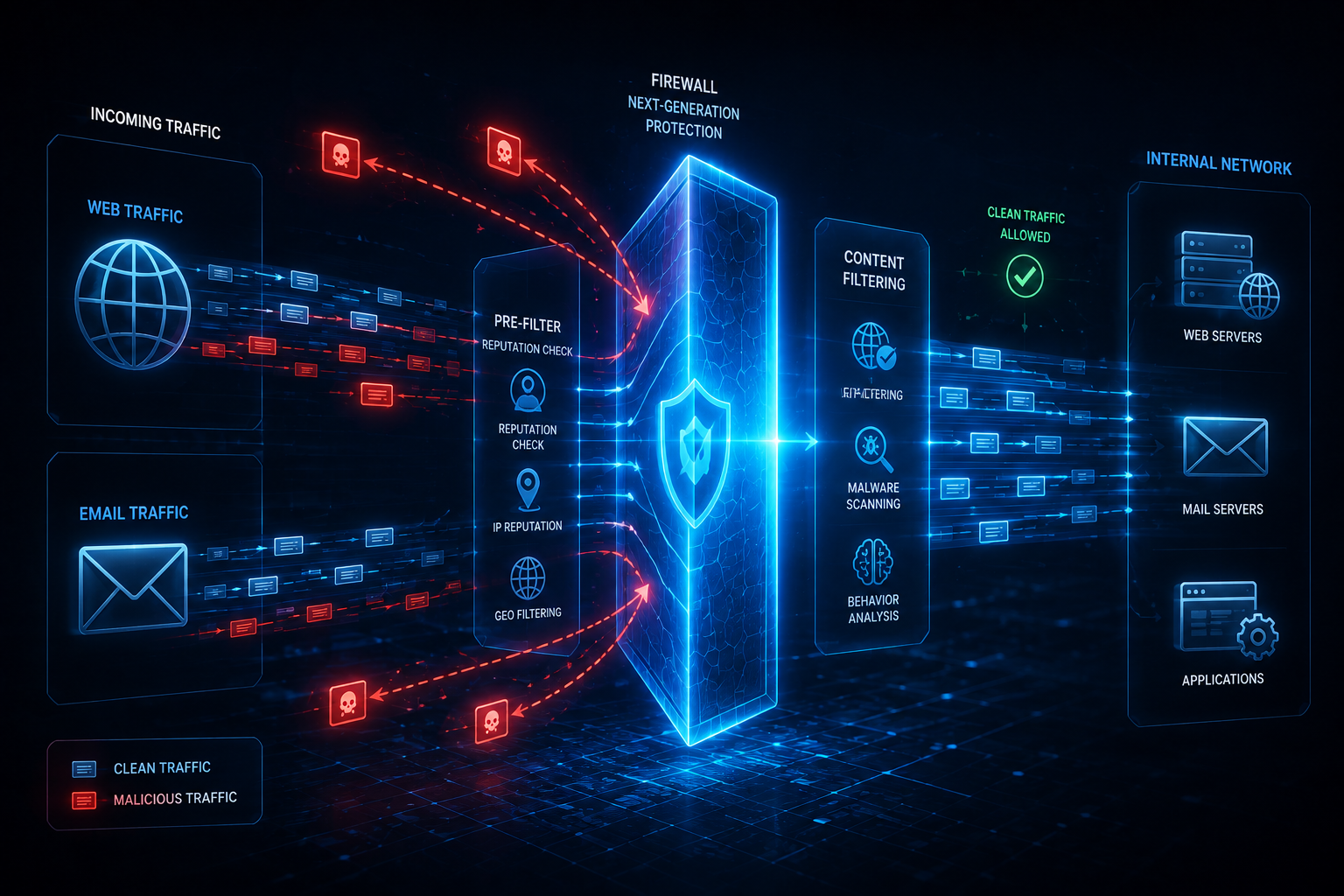
Before a packet ever reaches the internal routing fabric, it must be sanitized. Financial institutions expose numerous APIs, mobile banking backends, and customer portals to the open internet. These are protected by Web Application Firewalls (WAF)—utilizing robust solutions like F5 or Imperva—to thwart OWASP Top 10 attacks, credential stuffing, and SQL injections.
Simultaneously, the most common vector for initial compromise remains the human element. Mail Security Gateways sit at the edge to dismantle phishing campaigns, malicious attachments, and Business Email Compromise (BEC) attempts through zero-day sandboxing and SPF/DKIM/DMARC enforcement.
ALERT: SQL Injection Attempt Blocked
Source IP: 185.12.X.X (Geo: RU)
Target: e-branch.bankdomain.com/api/v1/auth/login
Payload: ' OR 1=1; DROP TABLE users;--
Action: DROP Rule ID: 942100 (SQLi Detection)
WAF Node: EXT-WAF-012. Identity Governance: IAM & PAM
In a Zero Trust architecture, identity is the new perimeter. Identity and Access Management (IAM) ensures that standard users and customers are who they claim to be, heavily relying on adaptive Multi-Factor Authentication (MFA) and contextual access (verifying device health and location before granting a session).
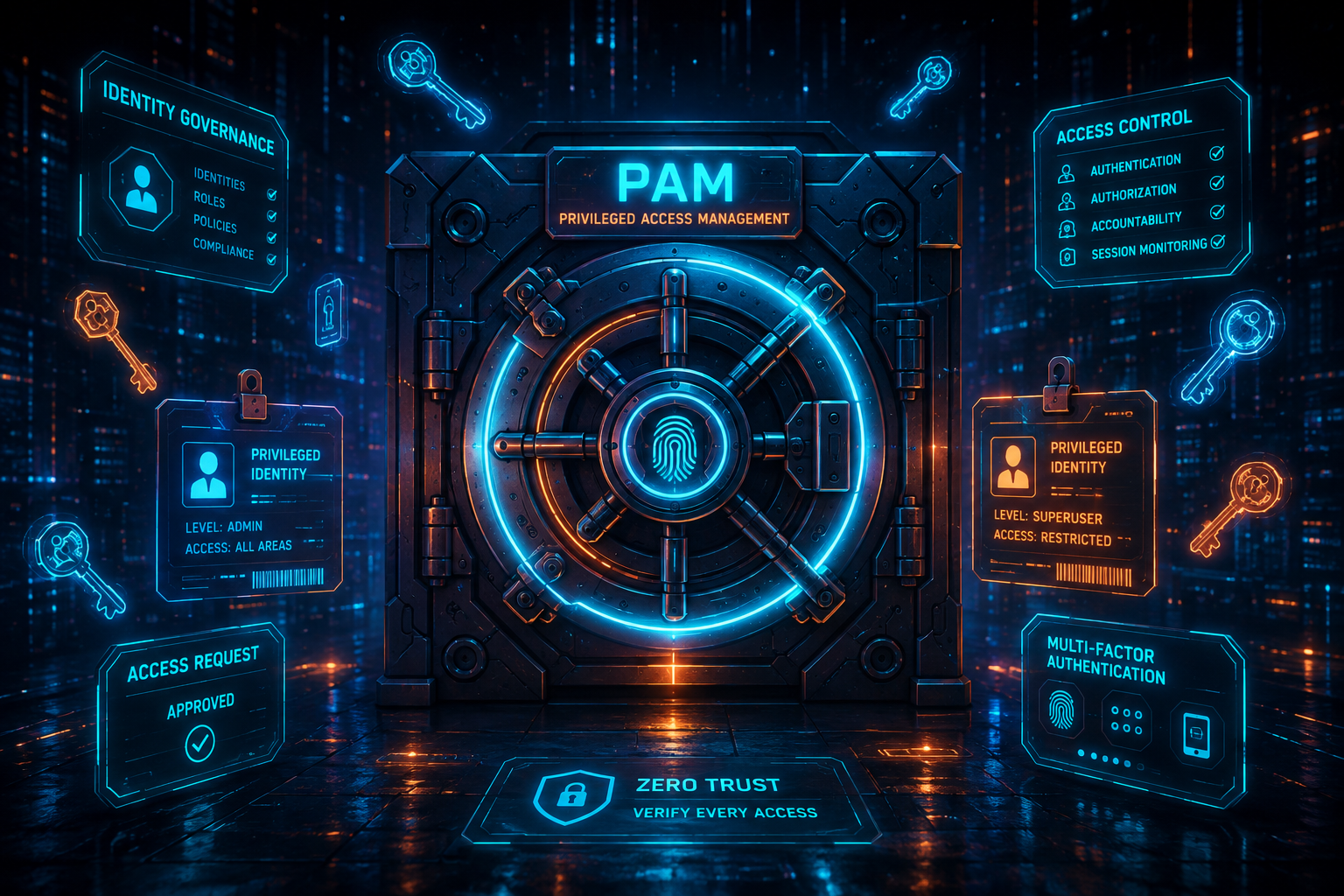
For IT administrators and database managers, Privileged Access Management (PAM) is non-negotiable. PAM strictly regulates access to Core Banking servers and sensitive databases. Administrators never know the actual root or admin passwords; instead, passwords are vaulted, rotated automatically, and every SSH/RDP session is recorded for forensic auditing.
PAM SESSION AUTHORIZED
User: e.guven@bankdomain.local
Target Asset: CORE-DB-01 (10.50.1.15)
Protocol: SSH (Port 22)
Authentication: Active Directory + Hardware Token (MFA)
Status: Session recording active. Vaulted credential injected.3. Internal Control: NAC & Micro-segmentation
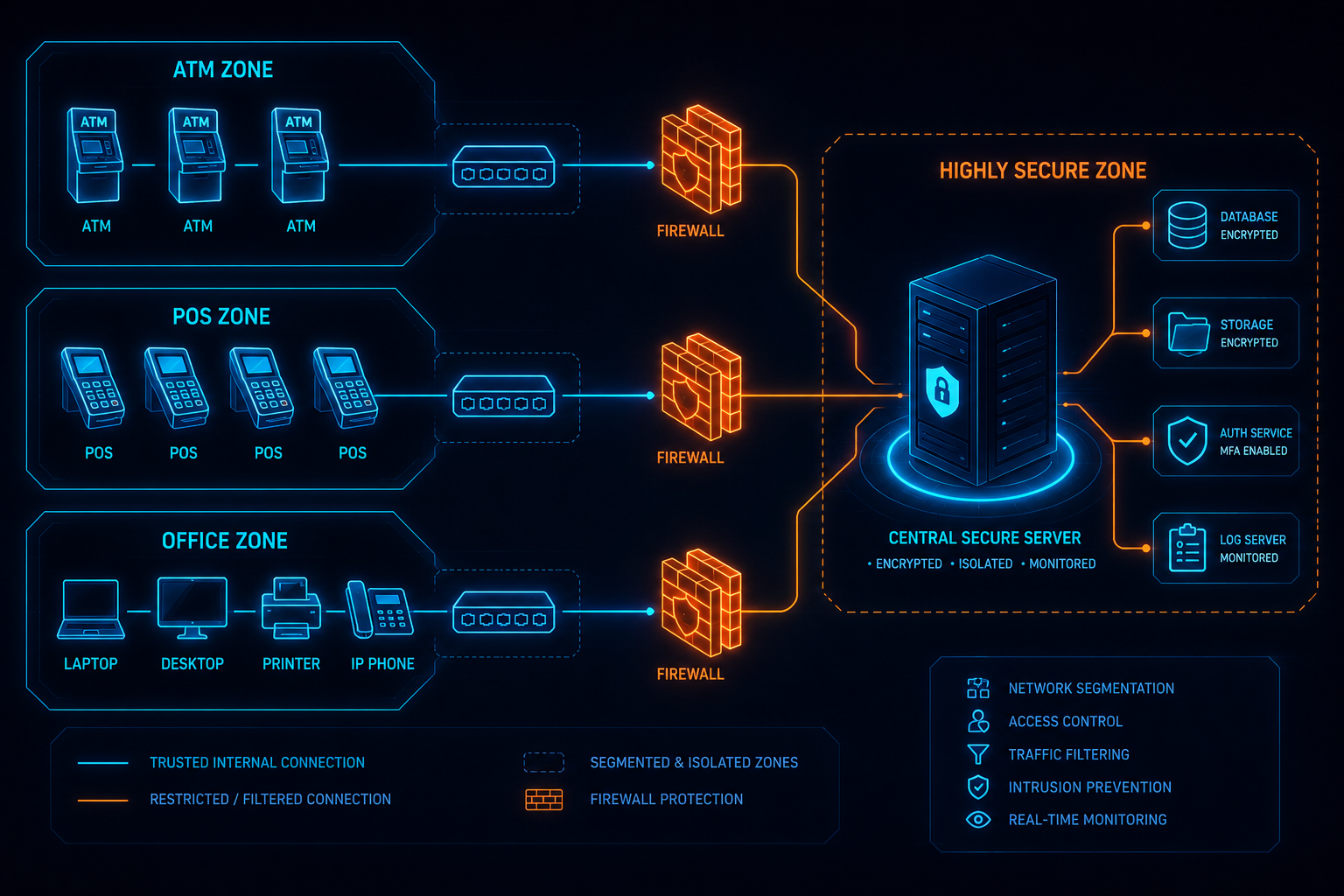
If an attacker successfully phishes an employee, lateral movement must be contained. This is achieved through aggressive internal segmentation. Network Access Control (NAC) solutions (such as ForeScout) passively profile every connected device—from employee laptops to branch printers and ATM endpoints. If a device lacks the corporate EDR agent or has outdated patches, the NAC dynamically assigns it to an isolated remediation VLAN.
Beneath the NAC layer, Micro-segmentation utilizes internal data center firewalls to create hermetically sealed zones. The SWIFT network, Core Banking applications, and ATM networks are completely isolated from standard office LANs. Only explicitly defined application-to-application traffic is permitted.
MAC: 00:1A:2B:3C:4D:5E
Device Profile: Windows 11 Corporate Endpoint
Posture Assessment: FAILED (EDR Agent Unreachable, Missing MS-08-26 Patch)
Action: Change VLAN Assignment -> VLAN 999 (Quarantine/Remediation)
Switch Port: Switch-Floor3-Gig1/0/124. Endpoint Integrity & Data Protection: EDR & DLP
The endpoint is where data is consumed, making it the frontline of defense. Endpoint Detection and Response (EDR) transcends traditional antivirus by monitoring process behaviors in real-time. If an unknown script attempts to encrypt files or inject into memory, the EDR agent autonomously kills the process and isolates the host from the network.
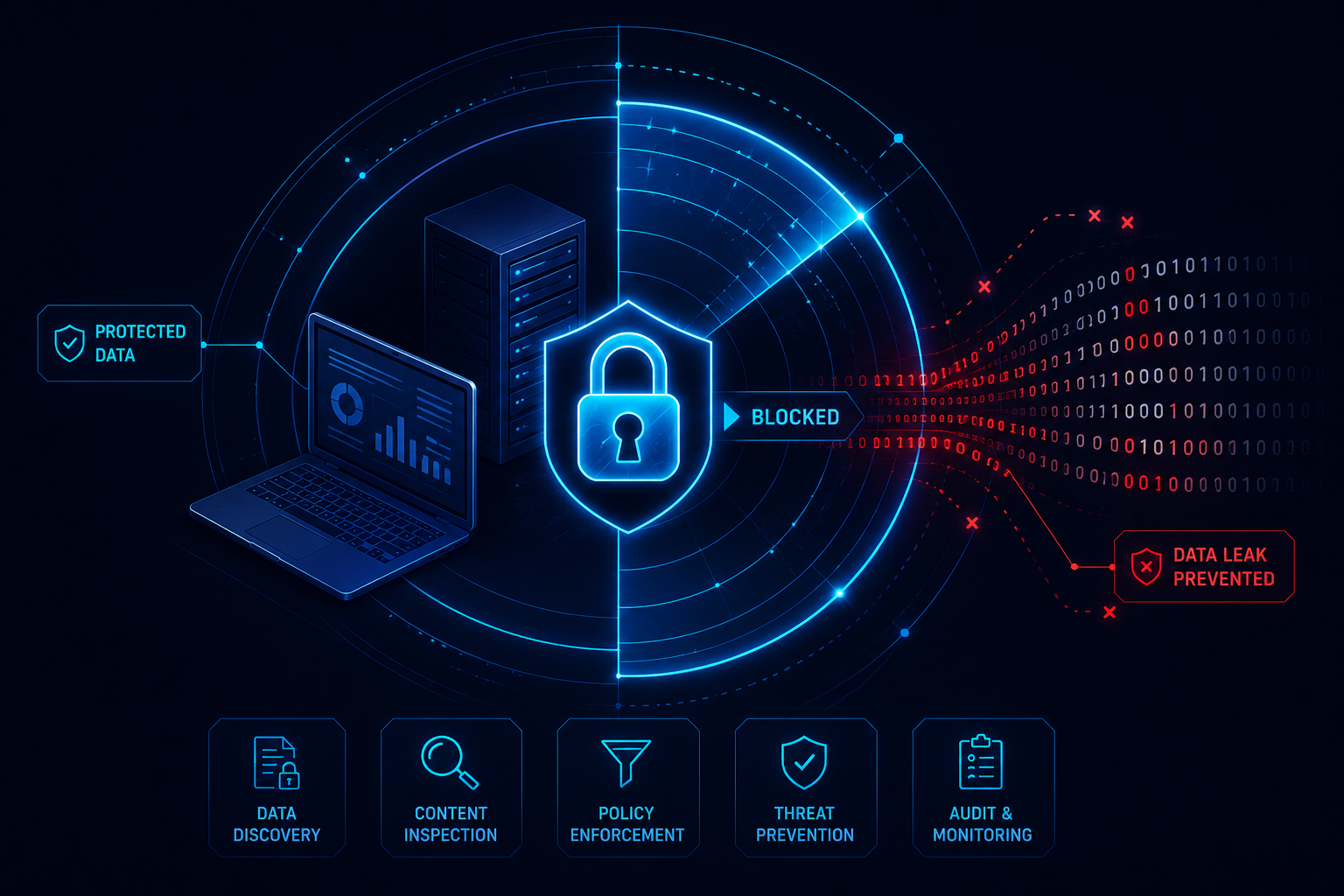
To comply with data privacy laws, Data Loss Prevention (DLP) enforces strict boundaries. DLP policies inspect data in motion (emails, web uploads) and data at rest. If a user attempts to upload an Excel file containing credit card numbers or IBANs to a personal cloud drive, the DLP engine blocks the transfer and alerts the SOC.
5. Proactive Defense: Vulnerability Scanning
Security is not a set-and-forget operation. Continuous Vulnerability Scanning is required to identify weaknesses before adversaries exploit them. This involves authenticated scans of servers, network infrastructure, and custom applications.
In a financial architecture, vulnerability management is risk-based. A critical CVSS score on a public-facing WAF node is patched immediately, whereas a medium-severity finding on an isolated internal test server is scheduled for the next maintenance window.

6. Central Visibility: Log Management & SIEM
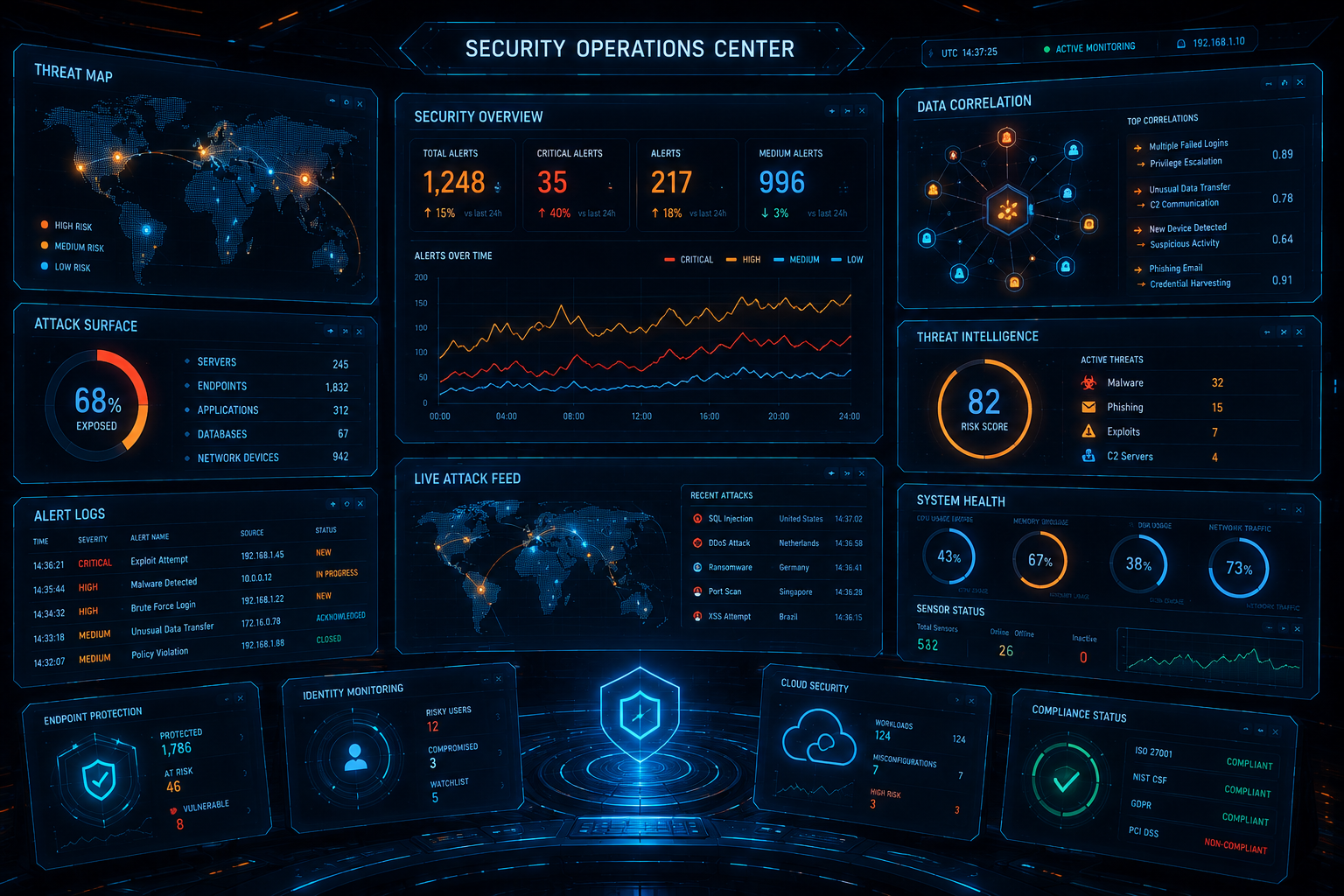
A defense-in-depth architecture generates millions of events daily. Without central visibility, these alerts are just noise. Log Management and SIEM (Security Information and Event Management) platforms ingest logs from the WAF, Firewalls, EDR, NAC, and Active Directory.
The SIEM correlates these disparate events. For example, a failed VPN login attempt from a foreign country, followed immediately by a successful login from the local city, followed by a request to access the Core Banking database, will trigger a High-Severity Incident Response playbook in the SOC.
CRITICAL CORRELATION TRIGGERED: "Impossible Travel & Privileged Access"
Event 1 [14:40:10]: Failed Login (O365) from IP 45.33.X.X (Geo: CN)
Event 2 [14:41:05]: Successful Login (VPN) from IP 212.156.X.X (Geo: TR)
Event 3 [14:44:50]: SSH attempt to Core Banking DB (10.50.1.15)
Automated Action: Suspend AD Account 'a.kaya'. Terminate active VPN session.Conclusion
A financial cybersecurity architecture is not built by merely stacking expensive appliances. It is a cohesive, integrated ecosystem where the WAF protects the edge, IAM verifies the user, NAC secures the local network, EDR protects the endpoint, and SIEM provides the overarching intelligence. Embracing Zero Trust and Micro-segmentation is no longer just an industry best practice—it is the baseline for institutional survival.